Blogs
Discover aftermarket insights, trends, and stories that keep OEMs and their customers connected and informed. Our platform helps OEMs expand their reach with genuine aftermarket parts and solutions, while guiding their customers to make smarter purchasing decisions with genuine, high quality products.
Part 2 of 3: The “Exclusive Aftermarket” Problem — Why Digital Twins Stayed Locked to Turbines and Aircraft
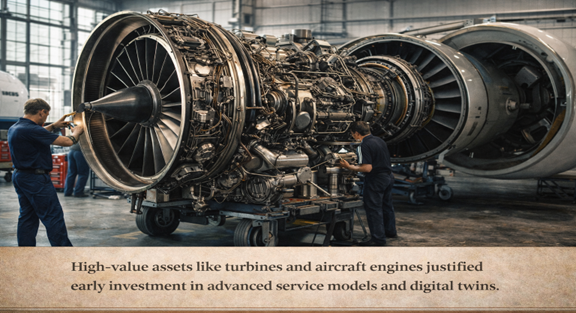
If you look at where industrial maintenance digitization advanced the fastest, a clear pattern emerges: digital innovation favored the most expensive, high-risk equipment first. Turbines, aircraft engines, large compressors, and mission-critical rotating machinery received the earliest and most sophisticated aftermarket systems—advanced service programs, predictive maintenance, OEM-connected diagnostics, and in many cases, fully engineered digital twins.
This created what might be called the exclusive aftermarket era—a world where only a narrow set of high-value equipment categories benefited from the most advanced service models. The reason was not technical capability. The reason was economics.
Building and maintaining a digital twin, especially in a way that supports aftermarket services, has historically been expensive. It demanded countless engineering hours, specialized modelers, highly structured BOM creation, and sustained maintenance of parts data. It also required constant updates to reflect design changes, installed configurations, and part substitutions. For turbines and aircraft engines, the revenue justified the investment. A single asset might support multimillion-dollar service contracts over decades. Digital twin investments were financially viable.
But for the rest of industrial machinery—the pumps, motors, blowers, valves, gearboxes, conveyors, and thousands of “everyday assets” that make factories run—the economics rarely worked. These machines are often high-volume, lower-margin, and widely distributed. Even when downtime impact is severe, the individual asset value does not justify the traditional cost of creating and publishing a true digital twin. For many OEMs in these segments, service revenue remained underdeveloped, and aftermarket programs stayed limited.
This imbalance created a structural disadvantage for much of the industrial equipment world. Many OEMs had the desire to grow service and aftermarket revenues, but could not justify the investment required to create the advanced cataloging systems and intelligence layers that high-value categories enjoyed. As a result, countless industrial operations continued relying on incomplete BOMs, static PDFs, tribal knowledge, and fragmented cross-reference lists. Substitutions happened without governance. Spare strategies were often reactive. And the “catalog” remained disconnected from the installed asset.
Yet here lies the deeper irony: most downtime is caused not by turbines, but by everything else. The majority of maintenance work in industry is performed on so-called “simple” or “mid-value” equipment. And these assets have long been underserved by digital approaches—not because they are unimportant, but because their service models were constrained by engineering cost.
The aftermarket industry has been waiting for a break in this equation. A way to make digital twin-level cataloging economically feasible for the broad base of industrial equipment. A way to eliminate the barrier of countless engineering hours. A way to bring turbines’ level of aftermarket intelligence to pumps, motors, and beyond.
That is the problem the next era is set to solve.