Blogs
Discover aftermarket insights, trends, and stories that keep OEMs and their customers connected and informed. Our platform helps OEMs expand their reach with genuine aftermarket parts and solutions, while guiding their customers to make smarter purchasing decisions with genuine, high quality products.
Blog Series: From Parts Books to Digital Twins — The Next Era of Industrial Aftermarket Catalogs
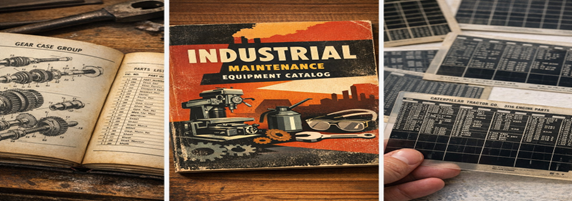
Part 1 of 3: The Long Journey of Industrial Machinery Parts Catalogs in America
For more than a century, the industrial economy of the United States has been powered by one simple truth: machines must be repaired to keep productivity alive. From textile mills and steel plants to railroads and refineries, uptime has always been the margin-maker. And for uptime to be possible at scale, industrial America needed one foundational system: parts catalogs.
The earliest industrial catalogs in the U.S. emerged in the 1800s, shaped by the rise of railroads, steam engines, and large-scale manufacturing. These were not “catalogs” in today’s sense, but printed parts lists and maintenance manuals distributed by manufacturers. Their purpose was practical: to ensure that owners could maintain complex machinery without requiring the original builders to be on-site. In these early years, parts were often not standardized. Some were custom-machined, fitted, or adapted locally. Documentation was sparse, but it marked the start of a new industrial language: naming parts, drawing assemblies, and communicating repair knowledge through print.
By the early 1900s, industrial OEMs began formalizing service departments and spare parts programs. Machinery was becoming more complex—compressors, pumps, turbines, cranes, presses, generators—and downtime was becoming more expensive. OEMs responded by publishing dedicated parts books containing structured lists, diagrams, and recommended spares. These books created order. They gave mechanics a reference. They enabled plants to stock critical components and rebuild machines with confidence.
At the same time, a parallel industry grew: the industrial aftermarket. Independent supply houses began offering standardized components—bearings, belts, seals, fasteners, couplings, gaskets—parts that could serve many machines across brands. This introduced interchangeability into the industrial world, and catalogs began to evolve into more than ordering tools. They became engineering references with dimensions, load ratings, materials, tolerances, and performance charts. Unlike consumer catalogs, these industrial catalogs were not just commercial artifacts—they were technical instruments used by engineers and maintenance teams to select and validate components.
The period from the 1950s through the 1970s became the “golden age” of printed industrial catalogs. Thick books filled stockrooms and engineering offices. OEMs produced assembly-level parts books with exploded diagrams, while distributors and component makers produced standardized catalogs covering thousands of part types. Industrial purchasing and maintenance professionals came to rely on them as the backbone of repair operations.
Then, the 1970s and 1980s brought a major shift: microfiche. As catalogs grew larger and update cycles accelerated, microfiche offered a way to compress vast libraries into compact, updateable formats. It improved distribution and reduced physical storage burdens, becoming the dominant format in many industrial and OEM environments.
The 1990s and early 2000s moved catalogs into CD-ROMs and early online portals, making lookup faster and distribution easier. But the limitations remained: catalogs were still static representations of information, not live reflections of what was installed. With the rise of CMMS and EAM systems, catalogs became more integrated into workflows—but the core challenge persisted: the gap between the catalog and the real asset in the field. And that gap is what the next era is poised to close.